Teammate Experience
Led design for three user types over three weeks for a single integrated experience. Leveraged the latest AI tools for UX Storytelling to challenge Software as a service.
Company
Role
Year
DaVita
Design Lead
2025
The Challenge
An elevated turnover trend
DaVita witnessed frontline employee turnover reaching 175% of pre-2019 levels. Business leaders acted quickly to decide between two options:
Commit to a 3 year contract with a SaaS provider to overhaul onboarding, or
Build an internal solution focused on onboarding, but designed to scale into a day 1 to retirement platform
To inform that decision, I was brought in as Design Lead to manage a team of designers and developers. Simultaneously, I partnered with the Corporate Strategy & given 3 weeks to present a compelling internal alternative to executives.
"I'm asked to train a teammate for 12 weeks on top of my full patient care work"
"I'm surprised how much RNs do, way more responsibility than at a hospital"
"I feel stressed—my hours were cut and financially, it put me in a difficult spot"
Increased Turnover
Frontline employee turnover reached 175% of pre-2019 levels. This sustained rise of turnover from the COVID era posed serious risks.
Acting Quickly
Business leaders were under pressure to act quickly. The question became stark and urgent:
Evaluating Options
To inform the decision, I was brought in as design lead to partner with the Corporate Strategy team, who hadn't worked with designers previously.
The Design Approach
Competing with a SaaS in 3 weeks
It was important to set the tone with the team early in the process. Although the median outcome leadership expected was to make the decision more difficult for the business stakeholders, I wanted the team to aim higher.
Starting from day one, I focused on clarity of the problem the design was meant to address & maintain momentum on the deliverable for the executive presentation.
Designing with three distinct user personas
We designed with three users in mind:
The Facility Administrator oversees progress & accountability
The Preceptor is responsible for training & support
The New Hire navigates onboarding for the first time

Facility Administrator
Francis Ashworth runs the Innovation Dialysis.

Experienced Preceptor
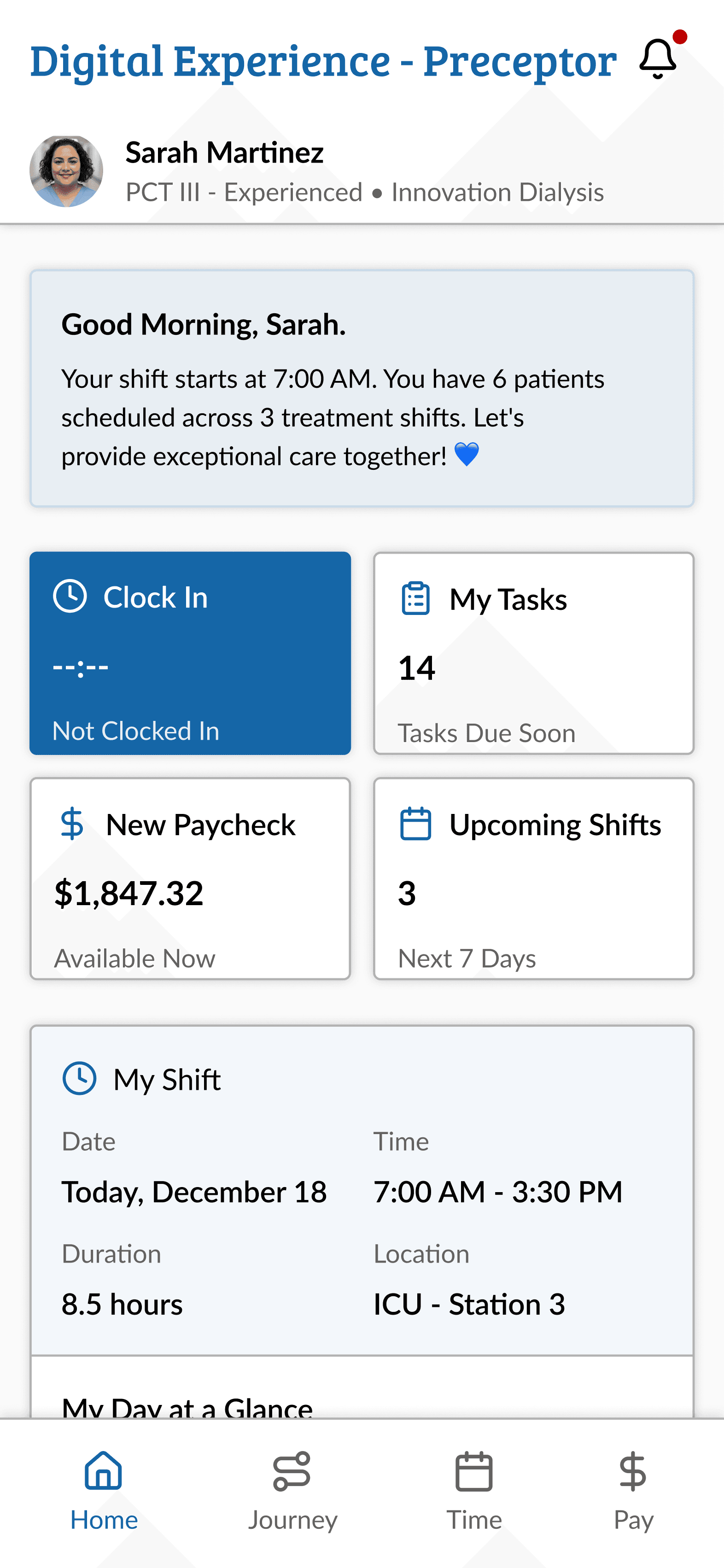
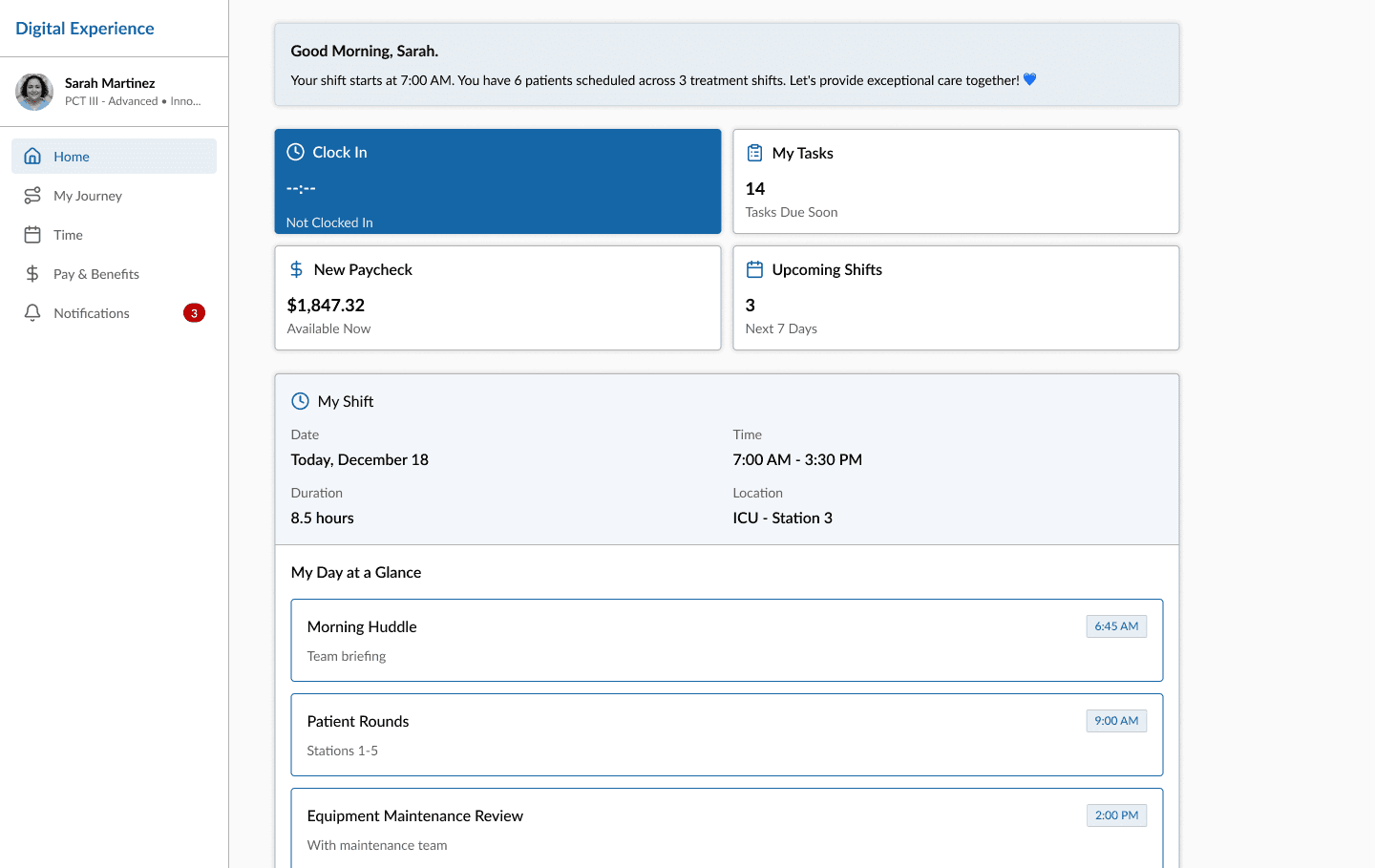
Sarah Martinez is a third year employee who trains Jessica.

New Hire
Jessica Chen is just starting her clinical journey.
Front loading Figma Make Prompts
I translated stakeholder feedback into a single, comprehensive Figma Make prompt, creating an artifact the entire team could react to immediately. The prompt became the backbone of our work & enabled the design team to move forward consistently.
Context
What's the problem we are solving & why are we solving it now?
"Application for in-house clinical employees and new hires training to work in healthcare"
Grounds the model's system in real constraints & prevents generic UI output
User & Environment
Who is this for? Where will this be used?
"Clinical teammates, time constrained, and often on shared devices within the clinic"
Optimizes for realism by designing for stress instead of ideal conditions
Core Job to Be Done
What is the single most important outcome?
"Reduce burden of the voluminous training for new hires within their first 90 days"
Forces prioritization by reducing over designing or over engineering a solution
Functional Requirements
What must the experience support?
"View available training courses, shortlist of the most important tasks, and check training status"
Enables fast layout generation & model can reason about structure
Constraints & Guardrails
What should we avoid?
"Mobile first application, accessibility AAA, no custom backend assumptions"
Reduces risk of time consuming design rework and maintains a quick to ship output
Design Direction
What is the balance with brand alignment & speed?
"Simple, calm, and enterprise grade, using DaVita's component library where possible"
Aligns visual language that incorporates existing assets while reducing research burden
Output Expectation
How do we know when it's done?
"Comprehensive application framework that facilitates specific functionality across devices"
Sets scope & speed, perfect for high pressure moments
Why This Works Under Pressure
Reduces ambiguity in a complex problem space before finalizing design details
Trades exhaustive spec document for experience clarity
Allows design to move at decision speed, not documentation speed
A structured approach to crafting prompts that produce focused, realistic, & shippable design outputs.
Designing & Building in Parallel
We operated in a compressed version of the Double Diamond:
Diverging quickly through multiple prototype directions
Converging daily based on stakeholder feedback
Shipping updated designs and code to engineering every day
The developers used AI-assisted tools like Windsurf to move at the speed of design concepts. Within 7 days, we handed off the core onboarding workflow across 3 user types, key interoperability components, & clean information architecture.
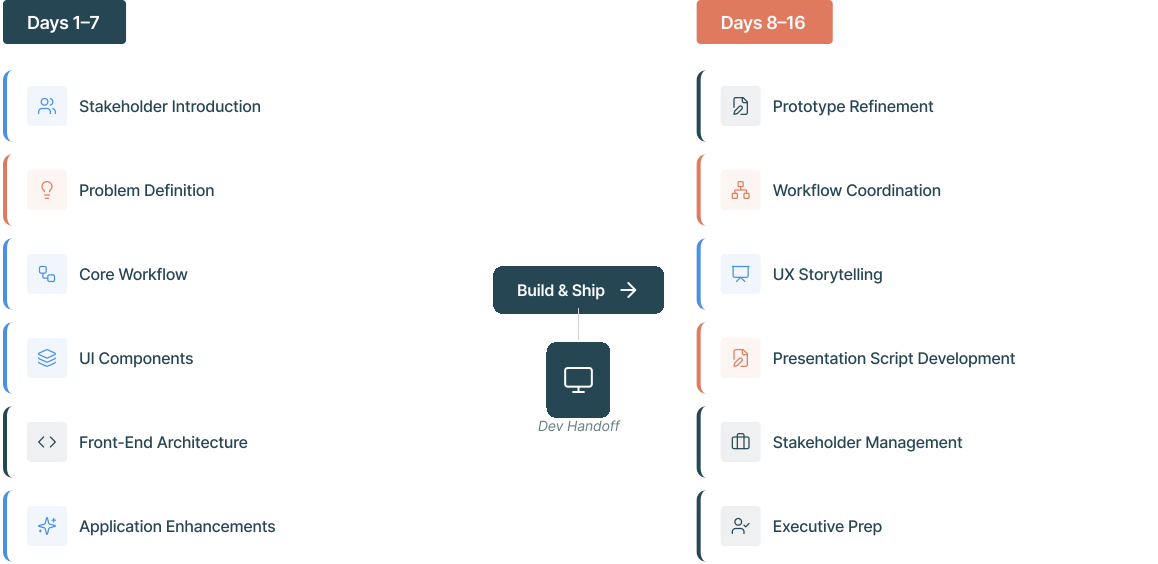
Rapid prototyping with development execution in two phases
The Solution
A single experience across three separate user roles
Presenting to the business stakeholder executive group needed refinement. I designed a custom, unified experience for the onboarding process across three separate user role types.
Facility Administrator
- Take action on behalf of new hires & assign training resources in a single flow
- Easily complete weekly check in documentation for existing employees
- Monitor health of all teammates' training status & ensure clinical compliance
Experienced Preceptor (RN)
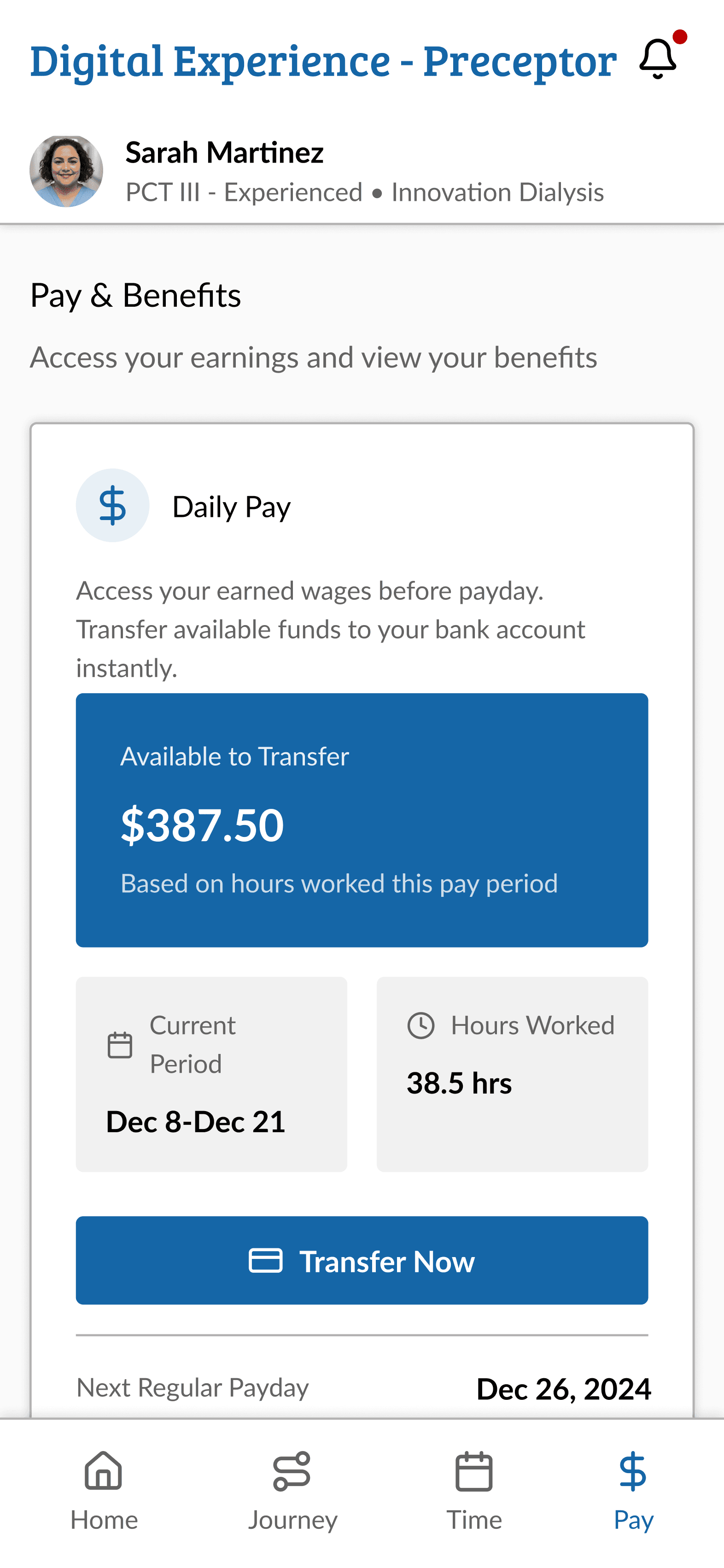
- Personalized home page with relevant tasks to easily begin shift
- Manage their own career journey & view long term growth within company
- Easily get to know & prepare for training responsibilities with new hires
New Hire (PCT)
- Immediate opportunity to take action on most important tasks, as supported by research
- Heads up display of most important daily tasks & easily access training materials
- Clear view of current career station & ability to see career growth path
Results
We presented the solution in consecutive executive demos along with ServiceNow on January 9th, in front of C-suite leaders across IT, Product, and People Services.
Even without an immediate win, DaVita's CPO actively campaigned for the internal build, reinforcing trust in the design vision & our team's execution.
The results of this project & the team's process showed:
Importance of design to influence multi-million dollar decisions
Showing how internal teams can compete with top vendors
Proving that speed, clarity, & trust can thrive in time constrained environments
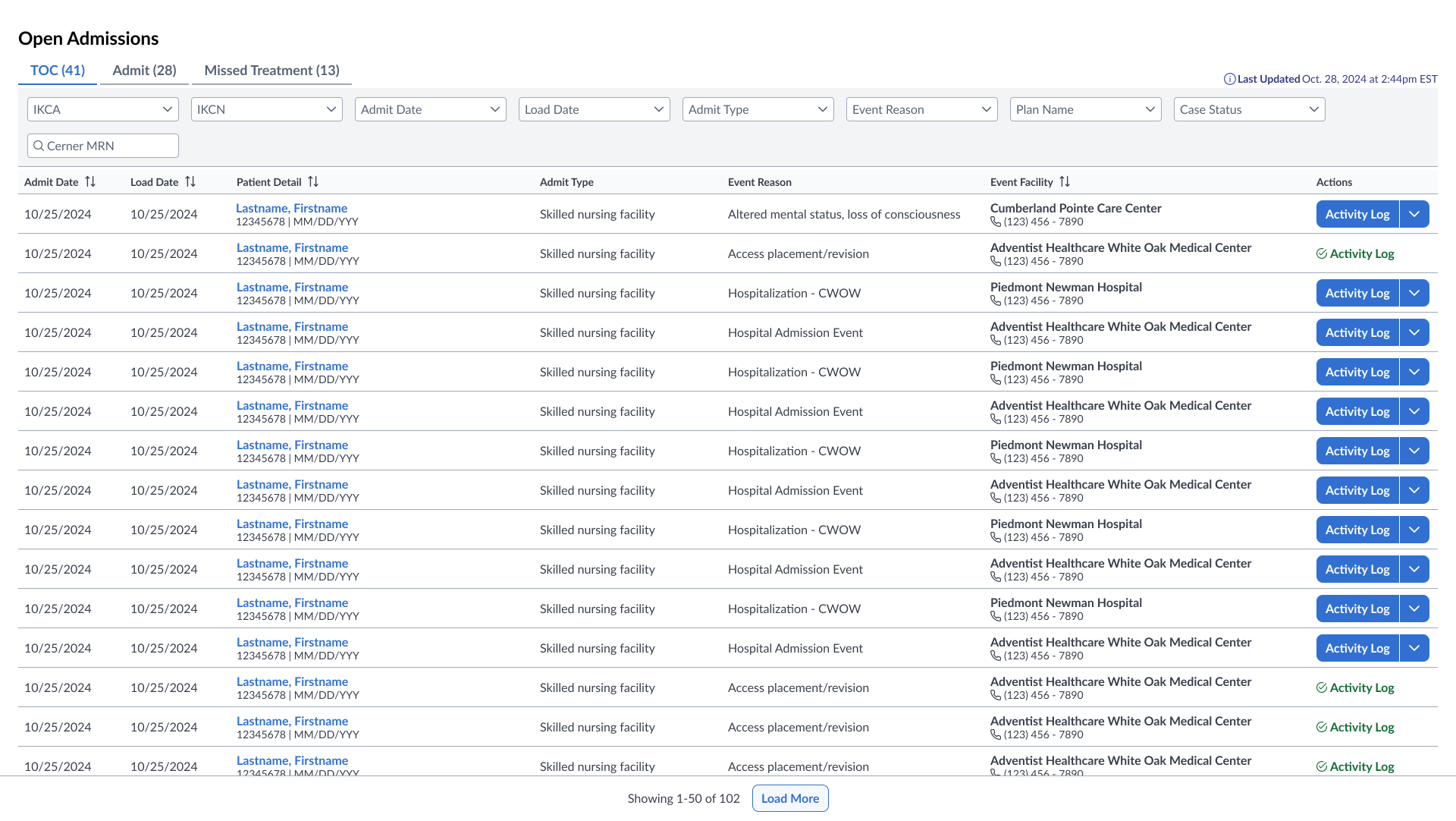
Open Admissions
Reimagining an inefficient interface to an intuitive workflow hub. Reduced task time by 30% & seeing an NPS score of 35.

AI Practices
I use AI to explore, build, and learn. It's an extension of my thinking that accelerates conceptual work, moving from theory to reality without sacrificing quality.
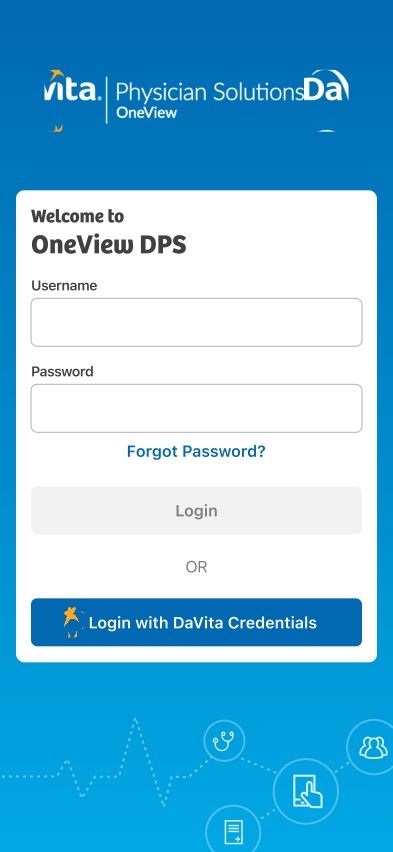
Modernizing OneView App
Repositioning OneView's mobile app to a trusted clinical companion—leading a redesign & a 40+ point NPS increase.